Big-Box Water Softener Not Working? Install vs. Programming
Bought a big-box store water softener and it’s not working? Learn how to spot installation vs. programming problems and when to call a plumber for help.
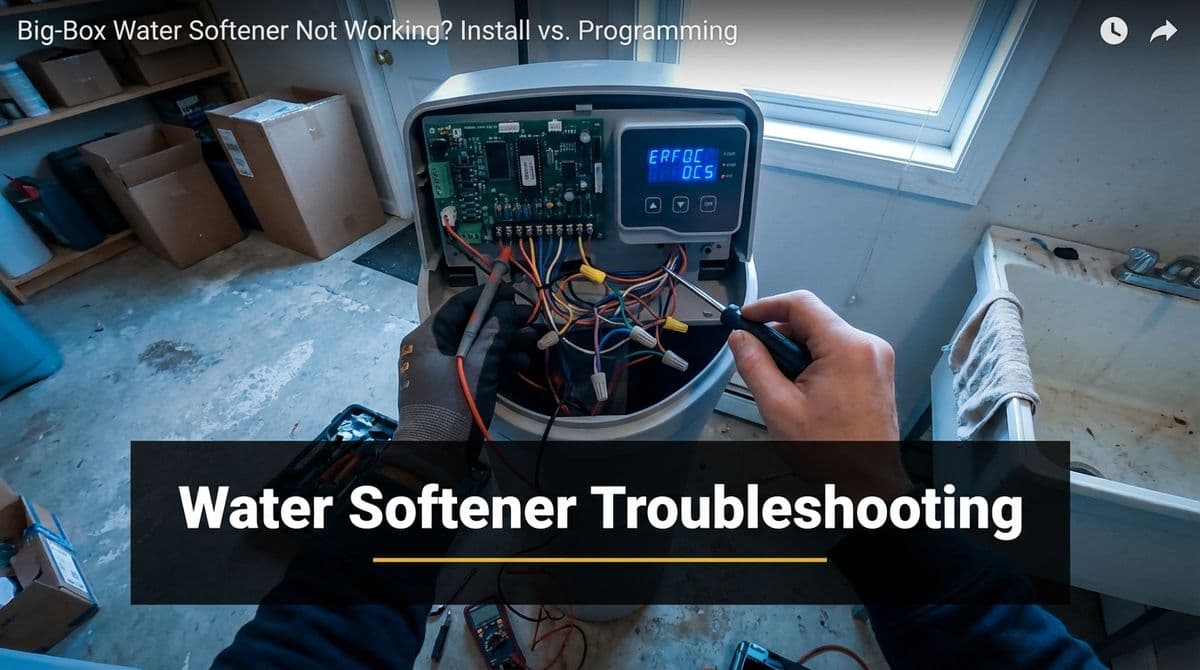
When a New Water Softener Doesn’t Soften: What We Look For
We recently got a call from a homeowner — let’s call him Mark — who had just bought an Aquasure Harmony water softener from a big-box store. He’d hired a “plumber” to install it, and from the day it went in, the system never worked right.
Mark told us, “He said he programmed it properly for me, but I know it’s not programmed right. It’s a 60,000 grain softener and I’m still getting hard water.” He had the instruction book in his hand, a brine tank full of salt, and a house that still felt like it never had a softener at all.
Situations like Mark’s are common: the equipment is fine, but something in the installation or programming is off. In this post, I’ll walk you through how we tell the difference between an installation problem and a programming problem — and when it’s time to call a licensed plumber.
First Step: Is the Softener Even On and in Service?
Before we get deep into diagnostics, we always start with the basics on any big-box-store softener like an Aquasure Harmony:
- Is the power on? Check that the unit’s display is lit and plugged into a working outlet.
- Is the bypass valve open? Most softeners have a bypass that can isolate the unit. In “bypass,” your house gets hard water as if the softener isn’t there.
- Is there salt in the brine tank? For a standard 60,000 grain salt-based unit, the tank should have several inches of salt above any standing water.
With Mark, we confirmed over the phone that his system was powered and had salt. The mystery was whether the problem was how it was hooked up or how it was programmed.
Signs It’s an Installation Problem
When we go on a service call like this, one of the first things we check is the plumbing layout around the softener. Here are common installation mistakes we see with big-box store units:
1. Inlet and outlet lines reversed
Most softeners are clearly labeled “IN” and “OUT,” but we regularly find them plumbed backwards. If the installer connected your home’s water to the “IN” side on the house piping instead of the valve, the system will cycle but won’t actually soften correctly.
What we look for:
- Arrows or “IN/OUT” labels on the control valve body
- Where the pipe from the main water supply actually connects
- Whether softened water is reaching a nearby fixture during a simple hardness test
2. System still in bypass
We also see softeners left in bypass mode after installation. Water flows through the plumbing, but it never enters the resin tank.
Quick homeowner check: Look behind the softener for one or more valves. In “service” position, the handle usually lines up with the pipe; in “bypass,” it’s turned perpendicular. If everything looks like it’s turned off to the softener, that’s a red flag.
3. No drain line or bad drain connection
A softener needs to send water to a drain during regeneration. If the drain line is:
- Missing
- Kinked or too high
- Improperly tied into another drain
the unit may try to regenerate and fail, leaving the resin full of hardness. That can make it look like a “programming” issue when really the system can’t clean itself.
4. Wrong fixtures on soft water vs. hard water
On some installs, the installer connects only part of the house. If your outside hose bibs or kitchen cold line are still on hard water (which is sometimes intentional), that’s fine — as long as you know. But if all your fixtures seem hard, or your water heater never sees softened water, the piping may simply be wrong.
Clues It’s a Programming or Settings Problem
In Mark’s case, the receptionist on our team explained that we’d start by checking programming on site. A big 60,000 grain system has to be set up for your specific water and household. If any of these settings are off, you may barely notice any difference in water quality.
1. Hardness setting is wrong
Most controllers ask for hardness in “grains per gallon” (gpg). If your water is 20 gpg but the unit is programmed at 10 gpg, it will regenerate too late and run out of capacity.
What you can do:
- Check your water bill or city website for typical hardness, or use a simple test strip kit.
- On many Aquasure-style units, enter a hardness number like 15–25 gpg for typical hard city water unless you have a specific test value.
2. Household size / capacity too low
Programming often includes how many people or how many gallons per day your home uses. If this is set too low, you’ll run through the softener’s capacity quickly.
As a very rough example, a family of four might use 250–300 gallons per day. On a 60,000 grain system, we might program it to regenerate every several days based on actual use instead of a simple fixed schedule.
3. Regeneration time and frequency
Most homeowners want regeneration at night, typically between 1 a.m. and 3 a.m. If the system is set to “time clock” mode and regenerates every night, you’ll waste salt and water. If it’s set to regenerate once every 14 days no matter what, you may never actually get consistent soft water.
Better setting: For many homes, we prefer a metered (on-demand) mode that triggers regeneration after a set number of gallons have passed, adjusted for your hardness.
4. Wrong system type (salt vs. “salt-free”) confusion
In the call, there was some confusion about whether the Aquasure Harmony was salt-free. It’s actually a salt-based softener — it must have the right kind of salt to work. If you accidentally treat it like a salt-free conditioner and never fill or maintain the brine tank, it will never soften.
Sample Programming Starting Points for a 60,000 Grain Softener
Every brand is different, but here’s a general idea of the kind of numbers we’ll use as a starting point when we set these up (we always adjust to the specific model and water test):
- Hardness: 18–25 gpg for many local city supplies (use your actual test when possible)
- People in home: 3–5 for an average family-sized house
- Regen mode: Metered/on-demand, not strictly time-based
- Regen time: 2:00 a.m.
- Salt dose: 8–12 lbs per regeneration on a 60,000 grain tank, depending on efficiency goals
Again, these are examples, not universal settings. But if your softener is set to hardness 5, one person, and a tiny salt dose, you’ve likely found why it “doesn’t work.”
Basic Maintenance to Keep Your Softener Working
Once we’ve corrected installation or programming issues, we always walk homeowners through simple maintenance so they don’t end up back at square one.
- Check salt monthly: Keep salt at least a few inches above the water level in the brine tank.
- Use the right salt: Pellets or solar salt made for water softeners — avoid products that leave heavy mush or debris.
- Watch for salt bridges: If salt forms a hard crust on top with a hollow underneath, gently break it up with a broom handle (don’t stab the tank).
- Test water hardness a couple of times a year: Simple strips can confirm that you’re still getting soft water at interior faucets.
When It’s Time to Call a Plumber
With Mark, we explained that our minimum service call covers coming out, checking programming, and making basic adjustments. If we discover that the lines are run incorrectly or major re-piping is needed, that’s a separate scope of work — but at least he’ll know exactly what’s wrong.
You should bring in a licensed plumber when:
- You’re not comfortable opening or changing programming menus.
- You suspect the inlet/outlet or bypass might be wrong but can’t tell.
- The unit throws error codes, won’t regenerate, or leaks.
- You’ve followed the manual and it still isn’t softening.
If you’ve bought a water softener from a big-box store and it just isn’t doing its job, don’t assume the equipment is bad. In many cases, a careful look at the installation and some expert programming is all it takes to get you the soft, clean water you were expecting in the first place.